Two powders with the same product name can behave completely differently in a mixer. One may flow freely at 0.4 kg/L while another at the same nominal density cakes at the wall above 8% moisture. This page works through the material classes we handle most often, what actually happens inside the machine with each, and which Saturn configuration is built for it.
Five properties that decide the equipment
Almost every specification conversation reduces to five measurable properties. Give us these and the mixer, the impeller, the shaft sealing and the discharge type follow fairly directly.
- Loose bulk density (kg/L) — sets the working volume, the impeller diameter and how hard the discharge has to work.
- Moisture content (%) — above roughly 8% powders clump; you need breaking action, not just circulating action.
- Flow behaviour — free-flowing, cohesive or bridging. This decides whether the machine needs a rotating-wall or plough action.
- Abrasiveness (Mohs / wear) — quartz, alumina and metal powders eat stainless quickly; they demand hardfacing or replaceable liners.
- Hygiene and containment class — food, pharmaceutical or chemical. This decides the steel grade, the sealing and whether discharge is contained.
Why we ask before quoting
A mixer quoted on product name alone will usually be over- or under-specified. A 500 L ribbon mixer and a 200 L double cone mixer can both be described as "for flour", and only one of them will hold uniformity on your actual batch. The material brief is short — density, moisture, batch size, target uniformity and cleaning method are enough for us to be accurate.
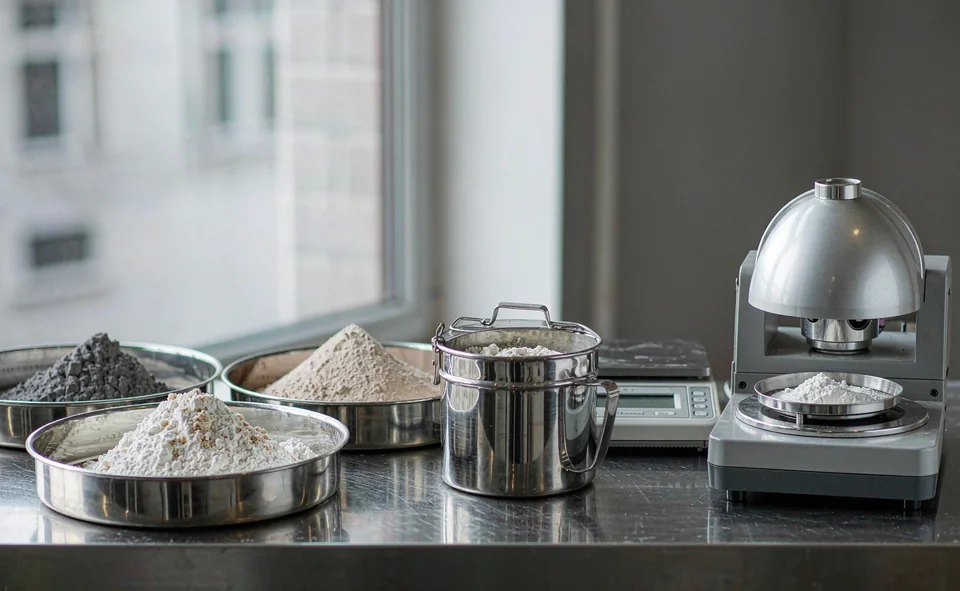
Material class to equipment matrix
The table below is the short version. Each row links to the equipment we normally build for that material class.
| Material class | Bulk density | Dominant behaviour | Typical mixer |
|---|---|---|---|
| Flours, starches, bakery powders | 0.4–0.7 kg/L | Free-flowing, shear sensitive | Double Cone Mixer |
| Seasonings, spice blends, coffee | 0.3–0.6 kg/L | Light, aromatic, segregation risk | Double Paddle Mixer |
| Pigments, colorants, masterbatch | 0.6–1.4 kg/L | Fine, agglomerating, staining | Plough Mixer |
| Battery & conductive powders | 1.0–2.0 kg/L | Dense, moisture sensitive | Ribbon Mixer |
| APIs & pharma intermediates | 0.3–1.0 kg/L | Cleanable, traceable, controlled | V Powder Mixer |
| Abrasives, quartz, mineral fillers | 1.2–2.5 kg/L | Highly abrasive, heavy | Plough Mixer + hardfacing |
| Gypsum, dry mortar, building powder | 0.8–1.6 kg/L | Free-flowing, high throughput | Rotary Drum Mixer |
| Powder cosmetics & personal care | 0.2–0.8 kg/L | Very fine, low bulk, tint-critical | V Powder Mixer |
Not sure which column applies? Browse the full powder mixer range, or skip to the material notes below.
Flours, starches & bakery powders
Wheat flour sits at roughly 0.45–0.65 kg/L and is genuinely free-flowing at low moisture — but it is shear sensitive, and unnecessary shear develops gluten and changes the dough behaviour downstream. The failure mode here is not blending; it is over-blending.
The right answer is a gentle tumble blender that turns the whole batch volume rather than shearing it. A double cone mixer achieves uniformity in a few minutes with almost no shear, discharges completely, and has no shaft seal to leak. Where the recipe includes a higher proportion of sugar or fat — which raises density and reduces flow — we move to a ribbon mixer for the extra convective action.
- Wheat & rye flour
- Corn & rice starch
- Milk powder
- Nutritional blends
- Bakery improvers
- Cocoa & coffee blends
Seasonings & spice blends
Seasoning blends combine a very light carrier with a small mass of heavy, strongly flavoured particles — chilli, salt, yeast, MSG, ground spice. The difficulty is not mixing speed but segregation: the heavy particles settle to the bottom, and any vibration during transport separates the blend again.
This is why seasoning lines favour low-shear action with a full-volume turnover. A double paddle mixer lifts material from the full height of the vessel rather than circulating only near the floor, so the heavy and light fractions stay together through the whole cycle. Volatile aromatic compounds are the second constraint — the machine should reach uniformity fast and stop, rather than run long at temperature. For lines where a pre-mix or post-mix grind is needed, our grinding equipment covers it; the industrial spice grinder is the usual pairing.
- Seasoning & spice blends
- Ground coffee
- Herbal extracts
- Soup & sauce powders
- Flavoured sugar & salt
Pigments, colorants & masterbatch
Pigment powders arrive as agglomerates, not as the individual particles they are meant to be. Agglomerated powder behaves badly: it floats, it does not disperse, and the visible result is colour streaking rather than a uniform shade — even though the mixer is technically running.
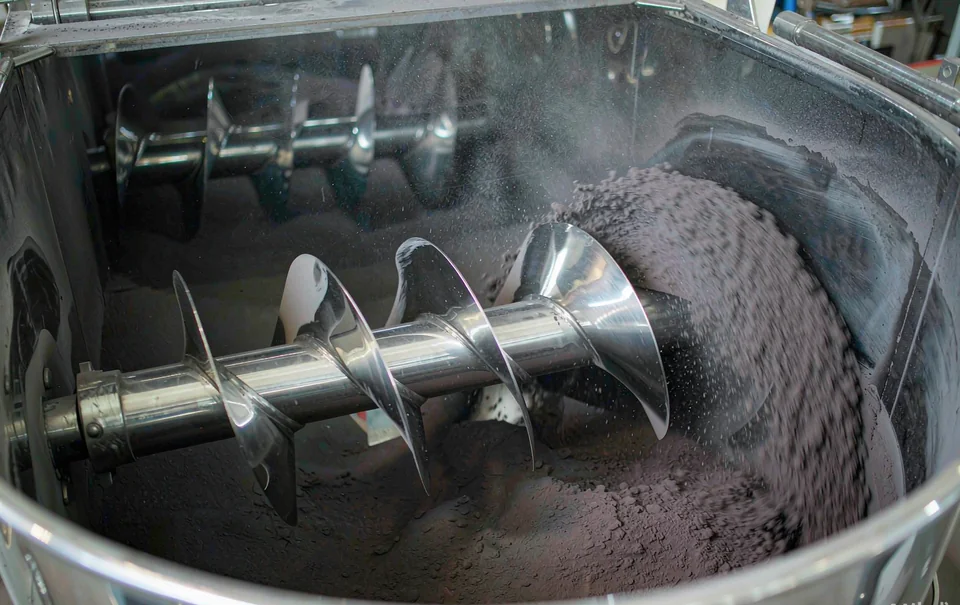
Breaking agglomerates needs high intensity, not high speed. A plough mixer uses ploughshare blades mounted on a rotating shaft to throw material against the vessel wall and break it down in a fraction of the time a ribbon mixer would take. Because pigments stain everything they touch, these machines are supplied with contained discharge and sealed connections — and they are usually specified as part of a full line rather than as a standalone mixer. Our chemical industry complete production line covers exactly this arrangement.
- Organic & inorganic pigments
- Masterbatch carrier
- Calcium carbonate filler
- Titanium dioxide
- Colour concentrates
Battery & conductive powders
Cathode and anode materials are dense — typically 1.0–2.0 kg/L — and hygroscopic enough that exposure to room air changes the batch. Two requirements follow: enough impeller power to move that mass, and a machine that can be closed to the atmosphere.
A ribbon mixer handles this combination well: counter-flowing ribbons move dense material through the full batch volume, and the full-length discharge opening empties the machine without leaving a heel of product exposed to air. Contained discharge, sealed shaft seals and nitrogen purging capability are added where the process requires it. The second half of the process is size reduction, where enclosed claw pulverisers keep the powder inside the machine rather than releasing it to the room.
- Lithium & LFP cathode material
- Anode & graphite blends
- Conductive additives
- Electrolyte salts
- Electrode coatings
APIs & pharmaceutical intermediates
Pharmaceutical blending is governed by three things beyond uniformity: cleanability, traceability and segregation control. The machine has to come apart completely and be cleaned without leaving a crevice, and it must not introduce foreign material into the product.
A V powder mixer is our usual starting point here: an angled paddle arrangement that blends quickly at low tip speed, lifts the whole batch, and empties through a clean discharge. It is supplied in food-grade stainless with sealed bearings, and specified so that contact surfaces can be polished to the standard your cleaning validation requires. Where a formulation is fragile and shear-sensitive, a double cone mixer is gentler still. For the full hygienic route from intake to packed product, see the food & beverage complete production line, which follows the same clean-design principles.
- Active pharmaceutical ingredients
- Excipients & fillers
- Granulation intermediates
- Suspension concentrates
- Dry powder blends
Abrasives & mineral powders
Quartz, alumina, silicon carbide and metal powders are the hardest applications we build. At 1.2–2.5 kg/L they are heavy, and they will cut through a standard stainless shell given enough mixing hours. This is not a mixer-selection problem so much as a wear-management problem.
We use high-intensity plough mixers because the action is effective and the cycle is short — which limits the wear budget. Where the application is continuous, the shell and ploughshare are hardfaced or supplied as replaceable wear parts, and we will specify the wear alloy as part of the quotation rather than treating it as an optional extra. If the material also needs size reduction, the colloid mill and pin mill are built with the same wear consideration in mind.
- Quartz & silica
- Alumina & aluminium oxide
- Silicon carbide
- Carbon black
- Metal & oxide powders
- Calcium carbonate
Gypsum, dry mortar & building powders
Building powders mix easily but move enormous volumes, so the constraint is throughput and wear rather than blend quality. Dry mortar lines run long campaigns, often around the clock, in dusty environments — which points to a design that discharges fully and cleans quickly.
The rotary drum mixer suits this pattern: a rotating drum with internal lifting flights blends by gravity as material is raised and cascades down, so there is no high-wear shaft seal in the product zone and the whole batch discharges with the drum reversed. Long campaigns also make dust control worth specifying properly, which is what the dust-collector-equipped pulverisers address on the grinding side. Downstream, dry mortar is almost always bagged in bulk — the big bag packing machine handles one-tonne bags on a load-cell-controlled weigh filler.
- Gypsum plaster powder
- Dry mortar & render
- Wall & floor screed mix
- Putty powder
- Tile adhesive
- Waterproofing powders
Powder cosmetics & personal care
Pressed powder, blush, foundation and talc-based products are extremely light — 0.2–0.5 kg/L — and very fine. Low bulk density means powder entrains air and will not settle into the working volume, and colour-critical products mean any segregation shows immediately as a shade mismatch.
A V powder mixer handles both problems: the angled paddles lift and fold the whole batch, breaking up aerated pockets, while the relatively low tip speed avoids generating more fines. Bloom, shimmer and pigment dispersion all improve when the batch is folded rather than beaten. Where the product must be milled very fine first, ultrafine pulverisers are specified in stainless with a dust-collected discharge.
- Pressed face powder
- Blush & bronzer
- Foundation powder
- Talc & body powder
- Bath salts & scrub bases
- Shower powder blends
When the material also needs size reduction
Many of the powders above arrive coarse or inconsistent and need milling before or after mixing. Where that step exists, it changes how the rest of the line should be configured — and it is often where the dust problem is actually created.
Ultrafine Pulverizer
High-fineness milling with a classifier for controlled particle size distribution.
View equipment → Food & spiceIndustrial Spice Grinder
Stainless construction for aromatic and food powders that must stay free of oil and heat.
View equipment → Dust-controlledPulverizer with Dust Collector
Milling and collection in one enclosed unit — keeps fines in the product, not the room.
View equipment → Wet & dispersionColloid Mill
Fine dispersion for pastes, slurries and pigment suspension.
View equipment →More options in the grinding equipment range.
Where the batch goes next
Uniformity is only useful if the batch arrives at the customer in the same state it left the mixer. The packing step sets how precisely that is preserved, and the choice depends on pack format and typical fill weight.
Powder Packing Machine
Auger filling with load-cell weighing and dust-controlled bag clamping for standard sacks.
View equipment → 500 – 1000 kgBig Bag Packing Machine
Bulk bag filling with pneumatic screw feed and arch-breaking for dense, bridging powders.
View equipment →Complete lines by material class
Where intake, conveying, mixing, buffer storage and packing all run as one enclosed system, the material never touches the room floor. That is where most of the quality and safety gains actually come from.
Chemical industry complete production line
Enclosed conveying, ribbon or plough mixing, buffer storage and automated packing for fillers, pigments and active compounds.
Explore the line → Complete line · Food & beverageFood & beverage complete production line
Hygienic construction, gentle blending and accurate auger filling for dairy blends, seasonings and supplements.
Explore the line →Real configurations built around these material classes are documented in customer cases, and the underlying process notes are in our process guides.
Material questions we are asked most
What bulk density range can Saturn mixers handle?
Working volume is normally specified between 0.2 and 2.5 kg/L of bulk density. Below 0.2 kg/L very light powders need slow, low-shear impellers and a de-aeration path; above 2.5 kg/L the discharge and shaft design have to change. Send us your loose bulk density and we will size the working volume accordingly.
Which mixer suits a free-flowing, low-density powder?
Free-flowing, low-density powders are best handled by gentle tumble blending — the double cone mixer or the double paddle mixer — because they achieve uniformity without the shear that would break particles. High-intensity ribbon or plough mixing is better reserved for agglomerated or damp material.
How does moisture content change the mixer choice?
Below roughly 8% moisture most powders mix freely and any mixer type will work. Above that level powders begin to clump and cake on the wall, so plough or high-intensity ribbon action is needed to break agglomerates rather than entrench them. Hygroscopic materials should be closed to the room air with sealed discharge.
Do you supply stainless steel for food and pharmaceutical powders?
Yes. Food, beverage, cosmetic and pharmaceutical applications are supplied in food-grade stainless steel with sealed shaft seals, polished contact surfaces and designs that allow full disassembly for wash-down or clean-in-place. Tell us your cleaning standard and we will specify accordingly.
Can one mixer handle several different materials?
In many cases yes. A ribbon mixer with a full-length discharge opening, a variable-speed drive and a stainless contact area can change between several powder recipes in the same day. Where materials differ sharply in density or abrasiveness, we will tell you honestly when a second mixer is the more economical choice.
Tell us what you are mixing
Bulk density, moisture, batch size and the uniformity you need to hold are enough for us to propose a specific machine — not a catalogue page.