In chemical manufacturing, mixing, conveying and packaging are not isolated steps — they are stages of one value chain. Connecting them into a single enclosed system is what removes the dust, the cross-contamination and the batch-to-batch drift that segmented production brings.
Why choose an integrated production line?
Traditional segmented production runs into the same four problems on almost every site: dust leaking at transfer points, cross-contamination between products, labour cost tied to manual handling, and quality that shifts from batch to batch.
An end-to-end line addresses these by joining each unit operation into a fully enclosed, automated system. The mixer is fed at a controlled rate, the material moves without being exposed to the room, and the finished blend reaches the packer without a manual transfer in between. The result is steadier quality, a cleaner working area, and throughput you can plan around.
Flow chart for the powder production line
The complete system is compact and space-saving, integrating the key components into one continuous configuration: bag discharging and feeding, mixing, finished-product packing, centralised controls and dust collection.
Feeding & bag opening systems
A combined small-bag / bulk-bag discharging station with integrated dust collection and a vibrating screen. Material enters the line in a clean environment, and oversized particles or debris are stopped before they reach the mixer.
Enclosed conveying system
Closed conveying prevents dust leakage and cross-contamination, and removes static build-up during transfer. The modular design keeps cleaning simple and protects material integrity along the route.
Mixing & homogenising systems
The mixer is selected against the material and the process: ribbon for general powders, plough for high-intensity dispersion, double paddle or double cone where gentler handling is required.
Intermediate storage & screening
A surge hopper or buffer bin balances the difference between batch mixing and continuous packing, so the mixer runs without interruption while the packer works at its own pace.
Automated packaging systems
The blend is discharged into a finished-product hopper fitted with an arch-breaking device to prevent bridging. A pneumatic butterfly valve feeds the valve-bag packer, which controls screw feed speed from load-cell signals — high fill accuracy with minimal dust.
Mixing options inside the line
Mixing is the stage that decides blend uniformity, so the line is specified around it rather than the other way round.
Ribbon Mixer
Counter-flow ribbons for uniform, low-shear blending of free-flowing powders.
View mixer →Plough Mixer
High-intensity ploughshare action for agglomerates and short cycle times.
View mixer →Double Paddle Mixer
Gentle turnover for fragile or low-density chemical powders.
View mixer →Double Cone Mixer
Tumble blending with minimal shear and easy full discharge.
View mixer →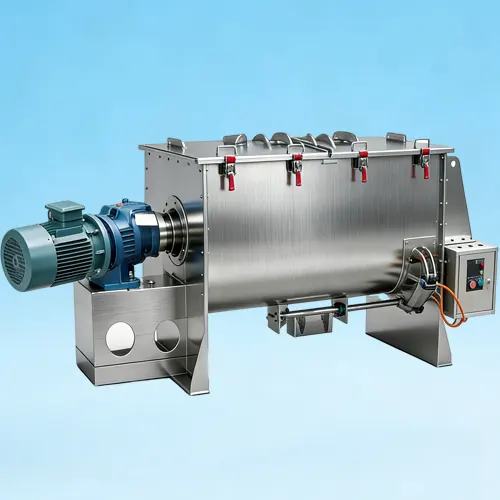
Typical line configuration
| Stage | Equipment | What it does |
|---|---|---|
| Feeding | Small-bag / bulk-bag discharging station | Dust-collected intake with vibrating screen |
| Conveying | Enclosed screw or pneumatic conveyor | Dust-free transfer, anti-static, easy to clean |
| Mixing | Ribbon / plough / paddle / cone mixer | Uniform blend, typically 5–15 minutes per batch |
| Buffer | Surge hopper with arch-breaker | Decouples batch mixing from continuous packing |
| Packing | Valve-bag packer with load-cell control | Accurate fill weight with low dust generation |
What this line handles
- Fillers & extenders
- Pigments & colorants
- Active compounds
- Additives & stabilisers
- Fine chemical powders
Containment where it matters
Dust collection is fitted at the intake and at each transfer point, and the conveying path stays closed end to end. For powders that are corrosive, volatile or hazardous, the same configuration is supplied with contained discharge and sealed connections.
Planning a chemical powder line?
Tell us the material, batch size and packing format. We will come back with a line layout, an indicative price and a lead time.
Request a line quotation← Back to all solutions