Detergent powders often combine materials with very different particle sizes, densities and flow properties. Builders and operators need a process that introduces each ingredient predictably, distributes low-dose components and prevents avoidable segregation after mixing.
Control the order of addition
Base powders can establish the batch bed before smaller additions such as brighteners, enzymes, fragrance carriers or colour components are introduced. The best order depends on the formula, but it should be documented and repeated from batch to batch.
Select mixing action for the formula
Ribbon mixers are widely used for dry detergent blends because their double-helical ribbons circulate material through the trough. Where the process requires faster deagglomeration, coating or a controlled liquid addition, a plough-style mixer and spray system may be a better fit.
Manage liquid additions carefully
Fragrance and other liquids should be distributed through a suitable spray bar or nozzle arrangement. Metering, droplet distribution and the timing of the spray determine whether the product remains free-flowing and homogeneous.
Protect the blend after mixing
Use appropriately designed discharge valves and enclosed downstream conveying to minimize product separation and dust. Packing should receive material at a rate that matches the line without extended hold time where segregation may occur.
The Complexity Behind Simple Cleaning
Modern detergent formulations combine primary surfactants that remove dirt and grease, builders that manage hardness ions, alkaline components for pH control, performance additives and sensory enhancers. These ingredients can arrive as fine powders, dense granules, viscous liquids and heat-sensitive biological components, so uniform distribution requires application-specific mixing.
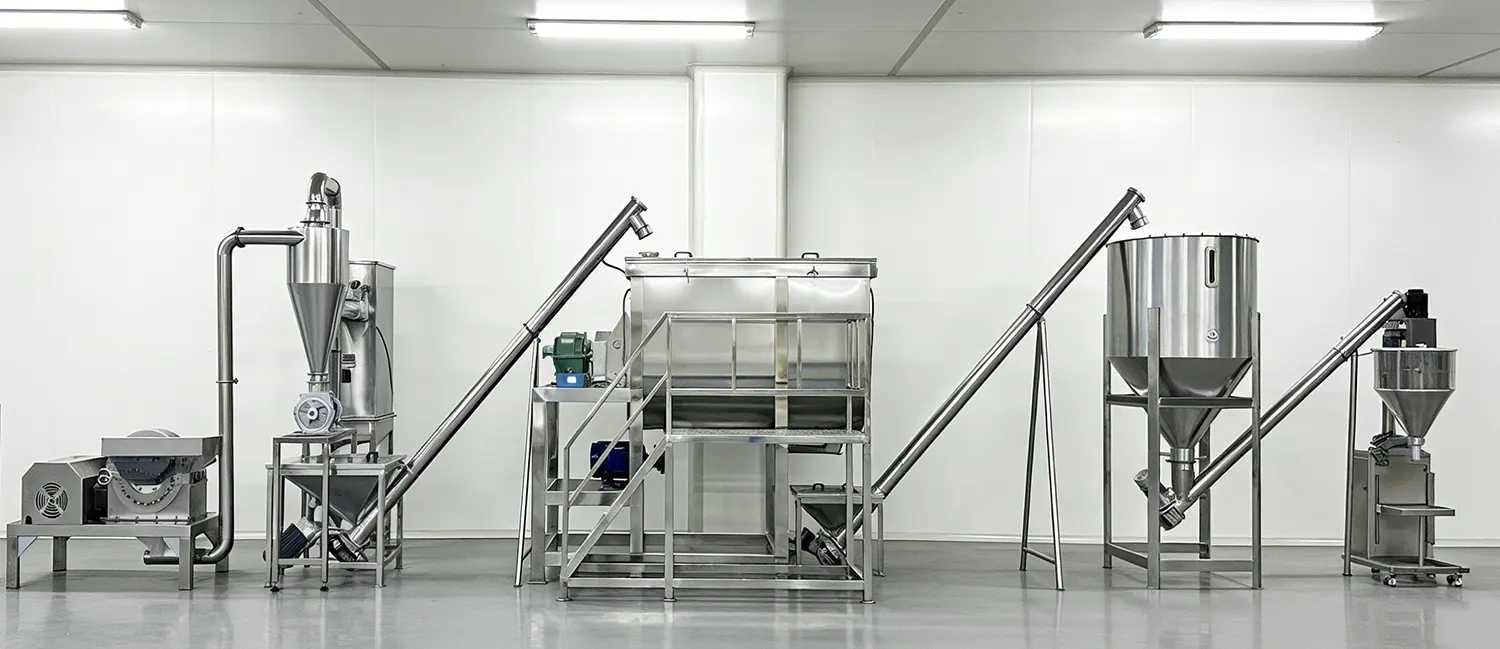
The Science of Detergent Mixing
Phase 1: Precision Dry Blending
Base powders such as soda ash, sodium sulfate and zeolites must be proportioned accurately and introduced without airborne dust. Automated bag-discharge stations with dust collection, sealed vacuum conveyors and loss-in-weight feeders or batch scales support clean transfer, prevent segregation and maintain accurate addition.
Phase 2: Liquid Incorporation
Surfactants, nonionics, perfumes and optical-brightener suspensions must disperse through the powder without lumps or wet spots. In a plough-shear mixer, plough tools create a moving powder bed while atomized liquid sprays penetrate it; choppers can break down soft agglomerates as they form. This supports rapid liquid absorption and repeatable batch quality.
Engineered for Your Process
No two detergent formulations are identical. For coloured speckles, encapsulated enzymes or perfumed granules that need gentler treatment, double-helix ribbon mixers provide thorough folding while protecting fragile components. A hybrid sequence can use intensive mixing for powder-liquid integration followed by ribbon blending for sensitive additions.
Complete Integrated Systems
- Raw-material receiving: bulk-bag dischargers and sack-tip stations with dust control.
- In-process transfer: vacuum conveyors and mechanical elevators matched to the layout.
- Weighing and dosing: micro-ingredient systems for enzymes and perfumes.
- Primary mixing: plough or ribbon mixers sized to the batch.
- Intermediate storage: surge hoppers with level control.
- Automated packaging: form-fill-seal, premade-bag or bulk-bag equipment.
- Plant-wide control and dust collection: recipe management, traceability and centralized or point-source collection.
Material Considerations: Building for Your Chemistry
Where detergent chemistry may be corrosive, specify appropriate contact materials and finishes, food-grade seals and gaskets where required, dual shaft seals and clean-in-place-ready drainage. Process validation should confirm the right construction for the formulation.
Why Partnership Matters
A durable detergent process requires process expertise, custom engineering, reliable scale-up and installation, operator-training and after-sales support. Equipment choices should also account for changing formulations, including compact powders, cold-water products and sustainable ingredients.
Need to Evaluate a Detergent Mixing Process?
Share the formulation type, target capacity and any liquid-addition or dust-control requirements with our team.
Request a Technical Review