Flour premixes, beverage powders, seasoning blends and many other dry food products depend on even ingredient distribution. A ribbon mixer is commonly selected because its inner and outer helical ribbons move material in opposing directions, creating a broad circulation pattern through the batch.
Where ribbon mixers fit
They are often suited to free-flowing or moderately cohesive powders and granules. The machine can be configured around batch volume, food-contact material, discharge arrangement and the type of ingredients being added.
Keep the process hygienic
Food production requires cleanable contact surfaces and a practical sanitation routine. Stainless-steel construction, smooth internal finishes, accessible openings and appropriately selected seals help operators clean efficiently between recipes.
Validate every recipe
Mixing time is formula-specific. Run trials with the actual ingredients, sample at multiple locations and establish the shortest repeatable time that meets the product specification. This process also helps identify whether an alternate mixer is needed for particularly fragile, sticky or high-liquid formulations.
Connect it to a complete food line
Enclosed screw or vacuum conveying can feed the mixer or move the finished blend to packaging. The material flow should be designed to prevent contamination and limit manual handling.
The Challenge: Mixing Isn’t as Simple as It Looks
Food manufacturers must control clumping in powders such as flour, milk powder and protein isolates; inconsistent levels of salt, sugar, vitamins and minerals; and the slow, variable results of manual mixing. Minor fortification ingredients can represent less than one percent of a recipe, yet still require uniform distribution.
How a Ribbon Blender Solves These Problems
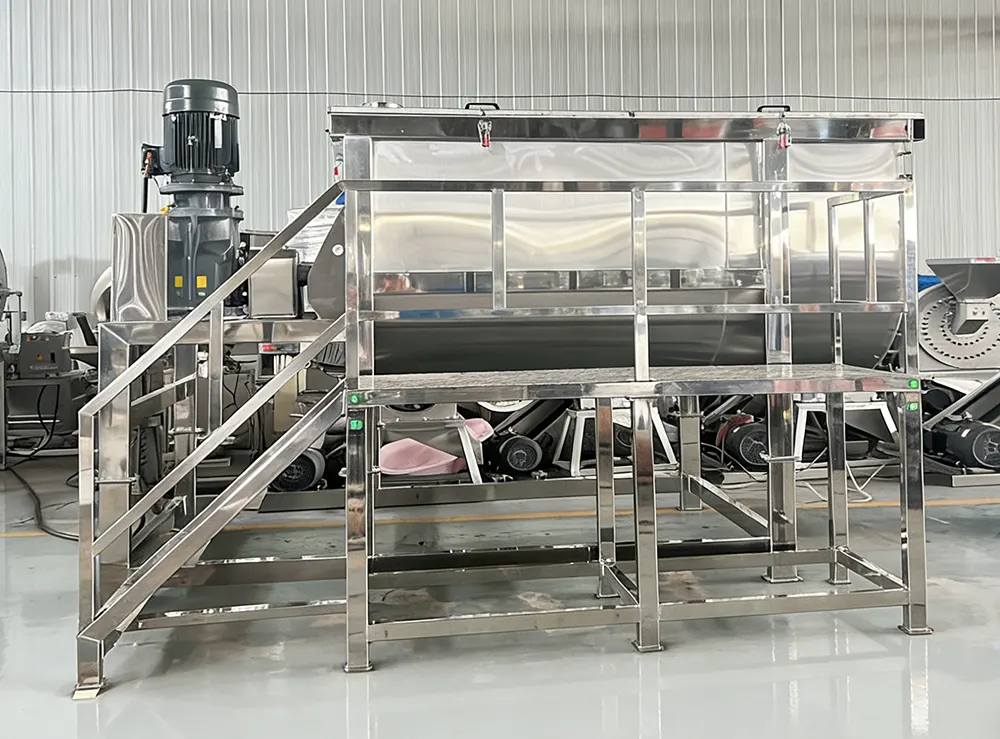
A horizontal trough and ribbon agitator create a simple but purposeful system. Inner and outer helical ribbons move material in opposing directions, producing continuous gentle folding and blending.
- Exceptional uniformity: appropriate processes can distribute active ingredients and base powders consistently.
- Gentle on ingredients: suitable handling can help preserve spices, dried herbs and cereal pieces.
- Fast cycles: typical batches may be blended in 5–15 minutes, subject to formula validation.
Where You’ll Find Ribbon Mixers in Food Production
Dairy & Nutritional Powders
Applications include whole and skim milk powders, buttermilk powder, whey concentrates and isolates, infant and toddler formulas, protein powders, meal replacements, senior-nutrition powders, milk protein concentrate, calcium caseinate, lactose and dairy permeate.
Spices, Seasonings & Savory Blends
Typical products include ground turmeric, cumin, coriander, chili powder, paprika, pepper, cinnamon, ginger, nutmeg, cardamom and cloves; curry, garam masala and five-spice blends; BBQ, poultry and fish seasonings; bouillon, gravy and sauce bases; and snack seasonings.
Instant Beverages & Drink Mixes
Ribbon mixers can be used for instant coffee, cappuccino, hot chocolate, chai and matcha mixes; iced tea, lemonade, sports and electrolyte powders; protein and nutrition shakes; functional beverage powders; and dairy-based drink mixes.
Confectionery, Dessert Powders & Food Ingredients
Further applications include pudding, custard, gelatin and jelly mixes, ice-cream bases, confectionery coatings and toppings, along with thickeners, stabilizers, preservatives, acidulants, sweeteners, colours and flavours.
Why Food Manufacturers Keep Coming Back
- Reliability: a simple mechanism supports sustained production with planned maintenance.
- Sanitary design: 304 or 316L stainless construction, polished interiors, radiused corners and clean-in-place options support hygiene.
- Scalability: the same principle can serve product development and full production capacities.
- Flexibility: liquid spraying, heating or cooling jackets and vacuum connections can be specified for the process.
Customers may never see the equipment, but they experience its effect in repeatable product quality. A properly selected ribbon mixer supports product quality, production efficiency and customer satisfaction.
Discuss a Food Powder Mixing Application
Tell us about the product, batch size, cleaning standard and required output.
Request a Food-Mixing Consultation