Large-scale flour production can involve more than bulk flour. Improvers, salt, enzymes, sugar, milk powder and micronutrients may all need to be uniformly distributed while maintaining the desired product texture and handling behaviour.
Match capacity to the true process rate
Size the mixer around the usable working volume, target batch cycle and upstream/downstream handling. Oversized equipment can be difficult to run at a consistent fill level; undersized equipment may become the bottleneck that disrupts packing.
Handle low-dose ingredients deliberately
Minor ingredients should be introduced through a documented procedure. Where appropriate, a premix stage can dilute very small additions into a carrier before the main batch, improving the chance of uniform distribution.
Design for sanitation and changeovers
Food-contact surfaces, easy-access openings and simple discharge geometry make routine cleaning more practical. Consider recipe frequency and allergen-management requirements before choosing the final configuration.
Use controlled transfer
After blending, transfer the product to packing in a way that minimizes segregation, dust and external contamination. Conveyors, intermediate hoppers and packaging equipment should be balanced around the same production rate.
Why Flour Mixing Demands Specialized Equipment
Flour contains particles ranging from fine dust to coarse bran fragments. Without the correct mixing action, fractions can segregate and lead to inconsistent downstream performance. Modern flour formulas also contain enzymes, ascorbic acid, malted barley flour, vital wheat gluten and vitamin/mineral fortification; additions below one percent still need precise distribution.
Types of Industrial Mixers for Flour Applications
Ribbon Mixers: The Workhorse for Dry Blending
A horizontal trough with inner and outer helical ribbons produces counter-current flow that repeatedly folds the batch. This gentle action can standardize flour streams, distribute enrichment ingredients, make bakery premixes and prepare seasoned flours while preserving particle integrity.
- Typical batch sizes: 100 kg to 5,000 kg.
- Typical mixing time: 5–15 minutes.
- Food-contact construction: 304 or 316L stainless steel.
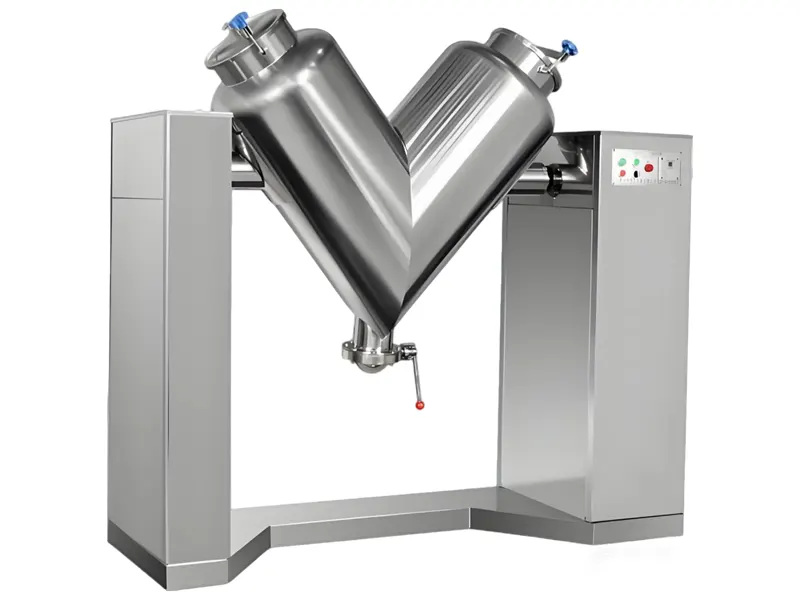
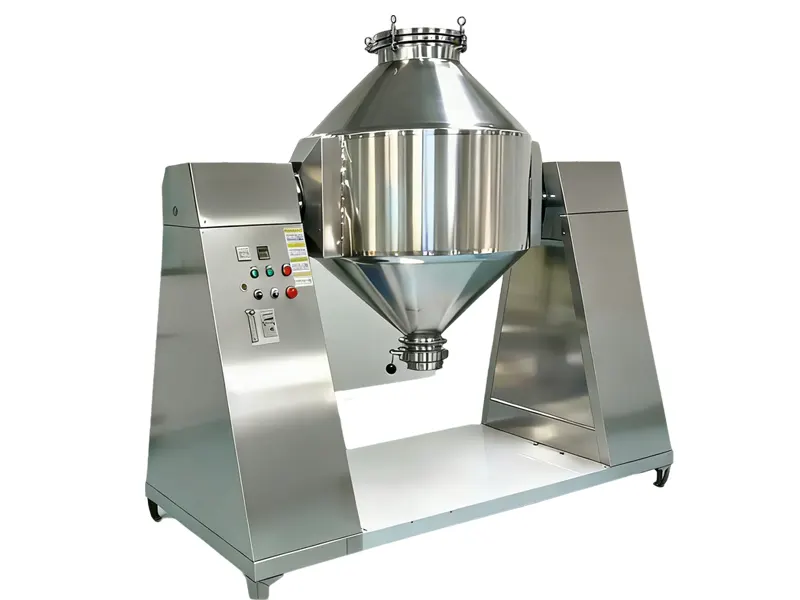
V-Type and Double Cone Mixers: Gentle Precision for Sensitive Applications
When flour products contain freeze-dried fruits, probiotics or delicate flavour granules, a rotating V-type or double-cone vessel provides gentle, diffusive mixing with low shear and heat generation. These units suit premium bakery mixes, nutritionally enhanced flours, small-batch specialty products and R&D work.
- Typical batch sizes: 10 L to 2,000 L.
- Typical mixing time: 7–10 minutes.
- Typical fill volume: 50–70% of total capacity.
From Single Mixers to Complete Flour Processing Lines
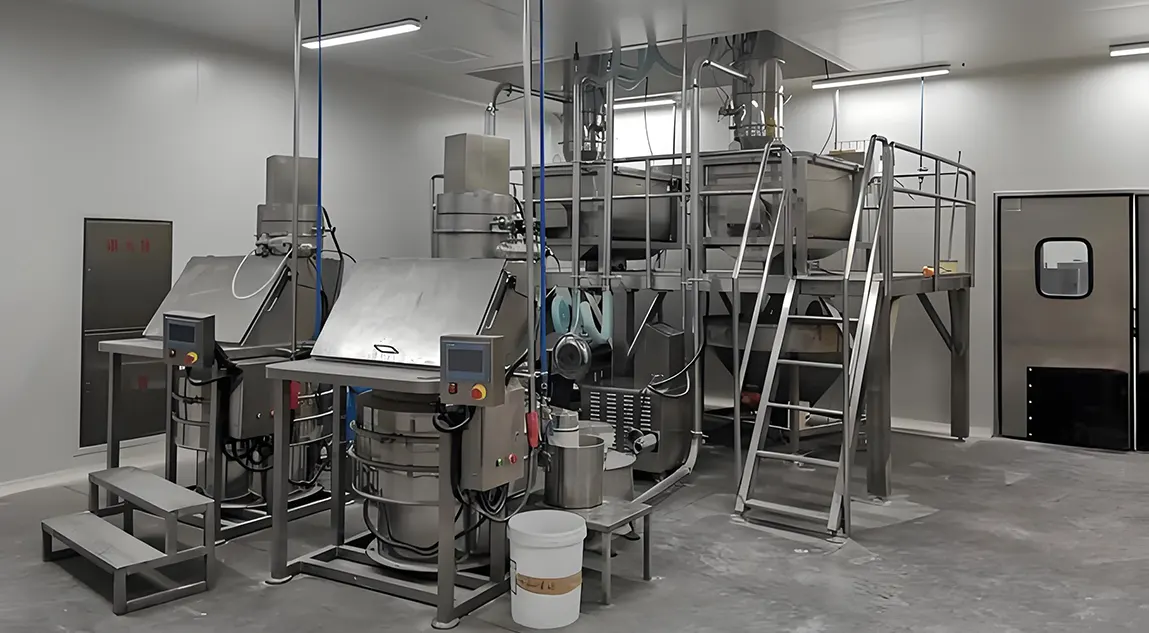
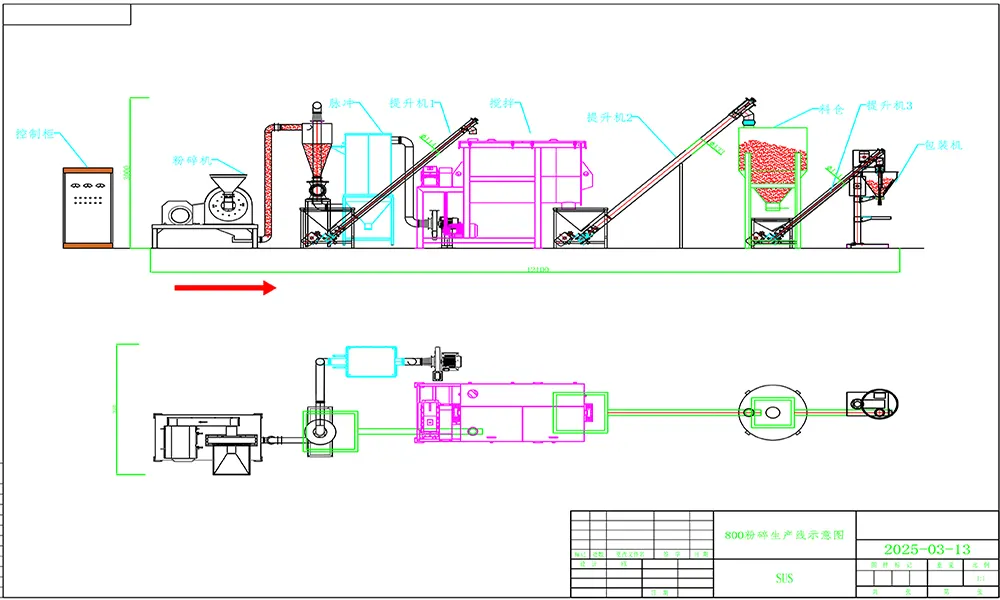
Integrated flour lines connect dust-controlled bag-dump and bulk-bag receiving, enclosed conveying, screening and magnetic separation, mixing, surge storage and automated packaging. Centralized dust collection maintains air quality and recovers product, while automation maintains batch parameters, prevents cross-contamination and supports rapid formula changeovers.
Key Applications Across the Flour Industry
Commercial Bakeries
Industrial bakeries use precision mixing to standardize bread flour across wheat sources, distribute bran and germ in whole-grain mixes, and incorporate dough conditioners, enzymes and oxidizers.
Flour Millers
Millers blend streams from different passages to meet target specifications, add vitamins and minerals at precise rates, and produce custom specialty flours.
Bakery Ingredient Suppliers
Premix and concentrate producers need uniform low-dose ingredients, rapid formulation changeovers and capacity that scales from development to production.
Material Considerations: Building for Food Safety
Food-contact surfaces should use appropriate stainless steel with polished finishes; seals and gaskets must be suitable for food contact. Crevice-free geometry and rapid access to shaft seals and discharge valves support inspection and cleaning.
Case Study: Custom Flour Blend Production
A specialty-baking-mix manufacturer with more than twenty recipes reduced changeover time and improved batch repeatability with a 2,500-litre ribbon mixer, rapid butterfly-valve discharge, integrated weighing and variable-speed control. The line connected with vacuum conveying and automated packing to create an integrated production system.
Why Partnership Matters
Equipment selection combines process expertise, formulation-specific engineering, scale-up planning and long-term installation, training and service support. In flour processing, the right mixing technology makes each loaf, bag and batch more consistent.
Planning a Flour or Dry Premix Line?
We can discuss batch size, formulation characteristics and the right mixer/conveyor arrangement.
Talk to Our Team