Metal and advanced ceramic powders can be sensitive to particle damage, segregation and contamination. The right mixing method depends on powder characteristics, required uniformity, batch scale and the acceptable level of mechanical stress.
What three-dimensional motion changes
A three-dimensional motion mixer moves the vessel through multiple directions rather than relying on a single agitator pattern. This can create broad, repeated redistribution of the material while limiting the local high-shear action associated with some other mixer designs.
When a gentle approach is useful
Gentle movement may be considered for compatible metal-powder blends, ceramic formulations, pigments and other material systems where preserving particle condition is important. It is not a universal answer: cohesive powders or processes that need deagglomeration may require another approach.
Validate the blend with the actual powder
Mixing time, fill level and vessel speed must be proven using representative material. A sampling plan should test uniformity at multiple locations, while the trial should also inspect the final powder for changes in particle morphology or segregation.
Relevance to advanced ceramics
Similar care is often required for ceramic powders containing binders, pigments or low-dose additives. The ceramic industry page outlines the application context and other potential mixing/conveying options.
What Makes It Work
A three-dimensional motion mixer has no agitators inside the mixing drum. Instead, the drum translates, rotates and rocks on multiple axes, producing a chaotic but repeatable flow path. Powders with different densities and particle sizes continuously fold into each other rather than relying on a single agitator pattern.
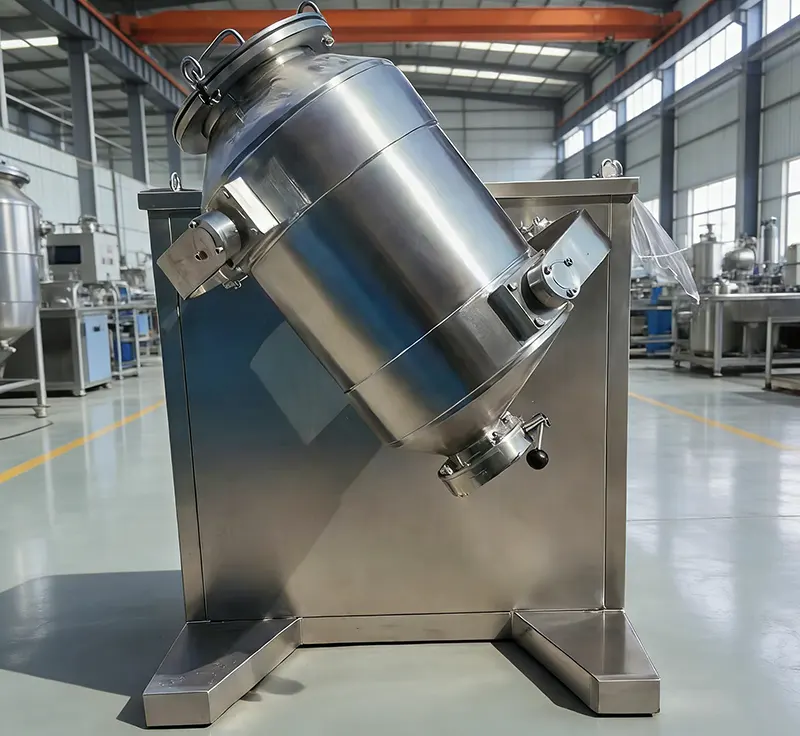
With representative material, suitable processes can target very low composition variation. For cemented-carbide production, consistent blending supports repeatable hardness and toughness in the sintered part.
Efficiency Without Damage
High-speed blades can change particle shape, generate heat and wear equipment. Low-speed three-dimensional movement may complete a typical batch in 10–20 minutes while helping protect powder morphology, particularly for high-value materials such as titanium-alloy powders used in additive manufacturing.
Clean and Contamination-Free
Without internal mixing tools, the drum has fewer potential wear points in the product zone. A smooth interior can be specified with suitable abrasion-resistant lining where needed, and accessible cleaning helps reduce carryover between formulations.
Smart Controls for Production Consistency
Recipe-capable controls can retain validated mixing time, drum speed and motion patterns, with recorded batch parameters supporting production consistency and traceability for high-value powders.
Where It Shines
- Cemented carbide: thorough blending supports consistent sintered density and mechanical properties.
- Silicon-carbide ceramics: gentle, uniform mixing can support sensitive ceramic formulations.
- 3D-printing powders: low-stress handling helps preserve spherical particle shape and flow behaviour.
No single mixer fits every material. For dry blends, small binder additions and multi-component systems where uniformity, low contamination and low particle stress are priorities, a three-dimensional motion mixer warrants process trials at the intended scale.
Discuss a Sensitive-Powder Process
Share the material category, batch size and processing objective for an equipment discussion.
Request Technical Input