In industrial production, material mixing is a critical step for ensuring final product quality. Due to density differences, light and heavy powders are prone to segregation — dense heavy powders tend to settle, while low-density light powders tend to float. This directly affects mixing efficiency and product performance. Therefore, achieving uniform dispersion of trace elements is essential. The difficulty of mixing powders with different densities significantly increases the complexity of the blending process.
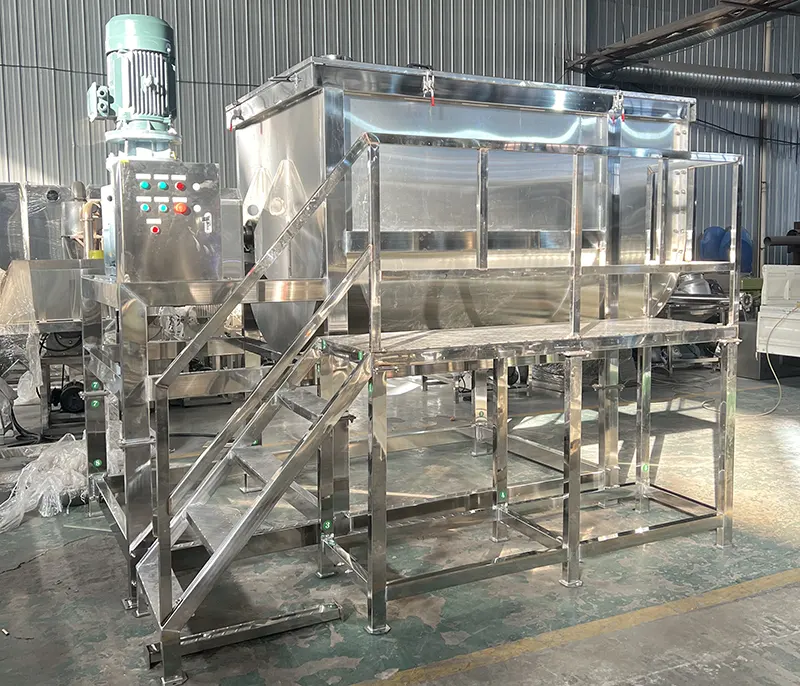
Core Challenges of Blending Light and Heavy Powders
- Gravity-driven settling: Heavy powders are strongly affected by gravity, often accumulating at the bottom of the ribbon mixer, making it hard to fully contact light powders.
- Suspension and floating: Light powders have low mass and high fluidity. They are easily suspended by airflow or local disturbances inside the mixing equipment, leading to local concentration or “pockets” of light material.
- Rapid re-segregation: If mixing time is insufficient or the equipment is poorly selected, light and heavy powders will quickly re-stratify after mixing stops, causing the mixing uniformity to fail.
Why Ribbon Mixing Equipment Is the Solution
To address these challenges, a ribbon blender uses a unique helical ribbon design to generate strong convective mixing, shear mixing, and diffusive mixing. The inner and outer ribbons rotate to create a continuous material flow — outer ribbons move material in one direction while inner ribbons move it in the opposite direction. This creates a three-dimensional tumbling and folding action that effectively wraps light powders into the bulk of heavy powders, preventing density-induced stratification.
The robust mixing action of the ribbon powder mixer ensures that light and heavy powders are uniformly dispersed at both macro and micro levels, significantly improving mixing uniformity and production efficiency.
Conclusion
In summary, for mixing light and heavy powders, the key is to choose equipment that can break density-induced stratification through forced convection while offering strong dispersion capability. The ribbon mixing equipment achieves excellent results through its helical ribbon design. In real-world applications, optimal performance depends on material characteristics, production scale, and precision requirements.
Discuss Your Application
Share your material, target capacity and process requirements with our engineering team.
Request a Quote